


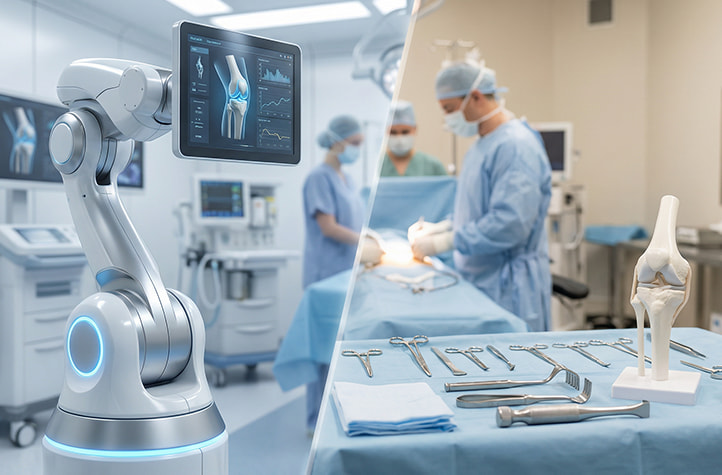
Knee replacement is a viable solution to persistent knee pain and disability from conditions like arthritis. It is common and significantly improves daily life, sleep, and mobility. Worldwide, an estimated ~3.6 million knee replacements were performed in 2023; across OECD countries, the average rate was ~156 per 100,000 people. In 2025, NICE conditionally approved several orthopaedic robotic systems (via Early Value Assessment), signalling growing adoption.
Robotic knee replacement aims to improve the success rate of the procedure through cyber-assisted precision: meta-analyses show fewer alignment outliers, though short- to mid-term function is often similar to conventional surgery.
This article explains what each approach involves, compares robotic knee replacement with traditional knee replacement, and summarises benefits, risks, and trade-offs to help you discuss options with your orthopaedic surgeon.
Overview of Knee Replacement Surgery
Traditional knee replacement resurfaces damaged cartilage in the knee with metal-and-polyethene implants. Robotic knee replacement adds CT/imageless planning and haptic guidance to refine implant positioning under the supervision of an orthopaedic surgeon. Both reliably reduce pain: around 89–90% of patients are satisfied, and 10-year implant survival commonly exceeds 90% in contemporary cases.
Why Knee Replacement Is Needed
For severe arthritis, traditional knee replacement restores function and relieves pain, and it has been employed as a treatment method for decades. Indications include osteoarthritis, rheumatoid arthritis, and post-traumatic arthritis. Robotic knee replacement targets the same goals with added precision.
What Is Robotic Knee Replacement?
Robotic knee replacement is a surgical procedure in which the orthopaedic surgeon uses computer planning and a robotic arm/hand-held tool to guide bone cuts and implant angles, helping match the plan specifically to your anatomy.
How Robotic Technology Assists Surgeons
In robotic knee replacement, pre-surgery entails a CT scan or imageless mapping to build a 3D model. Unique software proposes component sizes and target alignment, rotation, and slope tailored to anatomy.
In the operating theatre, haptic (force-feedback) guidance constrains cuts to the plan while sensors track alignment. Studies show fewer alignment outliers with robotic knee surgery. Early pain, function, and complications are often similar to those of traditional knee replacement.
Policy bodies (e.g., NICE/NHS) support guarded rollout with training and audit, helping patients weigh robotic knee replacement against traditional knee replacement as part of comprehensive care.
Common Robotic Systems Used
All robotic platforms are controlled by orthopaedic surgeons, who add planning accuracy and execution control to personalise alignment.
- • MAKO (CT-based, haptic arm): Pre-procedure CT sets a precise plan; intra-op haptics help achieve planned cuts/angles; studies report improved radiographic accuracy.
- • ROSA (image-based/imageless): Registers landmarks or uses imaging to build a 3D map; guides cuts and balancing; RCTs/series show accuracy gains with similar early function to conventional surgery.
- • NAVIO (imageless, hand-held): Real-time mapping with a burr-based tool; evidence shows improved component positioning versus conventional, with comparable early outcomes.
Robotic Knee Replacement vs Traditional Knee Replacement
Head-to-head studies show robotic knee replacement improves radiographic precision over traditional knee replacement, while pain, function, and complications are generally similar; operative time is typically longer during adoption under NICE/EVA-style governance. It refers to structured oversight frameworks used when introducing new medical technologies into clinical practice. This governance ensures that emerging technologies are used responsibly, with transparency and evidence-based evaluation.
Comparison at a Glance: Outcomes of Robotic and Traditional Knee Replacement
Advantages of Robotic Knee Replacement
Robotic knee replacement adds 3D planning and haptic execution to enhance placement accuracy compared with traditional knee replacement. Meta-analyses show fewer alignment outliers, while short- to mid-term pain, function, and complications are generally similar.
- • Precision and personalisation: 3D mapping tailors implant size, rotation, and limb alignment to each knee, reducing radiographic “outliers” versus manual techniques and standard jigs that support reproducible execution across varied deformities.
- • Smaller incisions and soft-tissue handling: Some systems can facilitate controlled bone cuts and balanced gaps; some series report reduced early tissue trauma/inflammation, though incision size varies and evidence is mixed for pain advantages.
- • Recovery and early outcomes: Early function and complications are similar to traditional knee replacement in pooled analyses; precision may support consistent rehab pathways even if short-term PROMs (patient-reported outcome measures) show no notable differences.
- • Durability signal: Better alignment theoretically lowers uneven wear; however, robotic knee replacement continues to show promising early and mid-term results, with long-term survivorship outcomes currently under evaluation as evidence continues to mature.
Disadvantages and Limitations of Robotic Knee Surgery
Robotic knee replacement can offer greater surgical precision, but it also comes with a few practical points patients should be aware of. The operation may take slightly longer at first, especially while surgical teams are gaining experience, though this usually improves over time and does not affect safety or recovery.
Moreover, the procedure requires specialised equipment and trained teams, so access may be limited to certain centres. Costs can also be higher due to the technology involved, and ongoing research is still evaluating long-term benefits compared with traditional knee replacement.
Overall, outcomes such as pain relief and mobility are similar with both approaches. Patients are encouraged to discuss their surgeon’s experience and whether robotic assistance is suitable for their individual needs, helping them make a confident, informed decision. These are the essential considerations before opting for a robotic knee surgery:
- • Higher cost: Capital and disposables add to case costs; cost-effectiveness depends on volume and outcomes.
- • Limited availability: Access is clustered in centres with trained teams and governance frameworks.
- • Longer theatre time: Typically 10–20 minutes early; narrows with experience.
Is Robotic Knee Surgery Better?
Robotic knee surgery offers greater radiographic precision than traditional knee replacement, chiefly by reducing alignment “outliers”. Across modern studies, however, short- to mid-term pain, function, complications, and early revisions are typically similar between approaches. What matters most for many patients is the experience of the surgeon and centre, robust peri-operative pathways, and rehab.
Choosing the Right Knee Replacement Option in Dubai
Discuss whether robotic knee replacement or traditional knee replacement suits your goals, anatomy, and timeline. Ask about volumes, infection/revision rates, imaging requirements, costs, and rehab, then choose an orthopaedic surgery team with transparent, audited outcomes.
- • What to discuss with your orthopaedic surgeon: Activity level, expectations, and medical history. Seek to understand whether robotic or traditional replacement fits your case.
- • Finding the best orthopaedic care: Seek an experienced orthopaedic doctor in Dubai, and confirm physiotherapy and follow-up protocols.
Conclusion
Robotic and traditional knee replacement are both viable. Choose the approach that fits your goals, anatomy, and recovery preferences after discussing risks, benefits, and rehab support. For personalised guidance and a structured plan, book a review at the best orthopaedic hospital in Dubai to assess your scans, expectations, and next steps.
FAQs
1) Is there a distinction between robotic and traditional knee replacement?
Robotic knee replacement uses CT/imageless 3D mapping and haptic guidance to help the surgeon place implants more precisely; it reduces outliers. Short- to mid-term pain, function, and complications are generally similar to traditional knee replacement.
2) What is the success rate of robotic knee replacement surgery?
Knee replacement overall reports ~90% patient satisfaction in modern cases, with many implants showing ~90% or more survivorship at 10–15 years. Robotic techniques primarily improve radiographic precision rather than short-term PROMs.
3) What are the advantages of robotic knee replacement?
Improved planning and execution with fewer alignment outliers and accurate component positioning; support conditional adoption with training/audit, while long-term advantages are studied.
4) What are the disadvantages of robotic knee surgery?
Longer operative time (~+10–20 minutes reported), higher capital/usage costs, and infrastructure availability are the common trade-offs of robotic knee surgery compared to conventional methods
5) How long does recovery take after robotic knee replacement?
Early recovery typically takes 6–12 weeks, with improvements continuing for months; full recovery can take up to a year. Physiotherapy and adherence to your programme are key.
6) Is robotic knee surgery suitable for all patients?
Both techniques suit the same indications (advanced arthritis with failed non-operative care). Suitability depends on anatomy, comorbidities, surgeon/centre experience, and technology access—not every case needs robotics.
7) Where can I find the best orthopaedic care in Dubai for knee replacement?
Seek a reliable and best orthopaedic hospital in Dubai that publishes audited outcomes and offers clear rehab pathways; ask about surgeon volumes and whether robotic knee replacement or traditional knee replacement fits your case.
References
https://pubmed.ncbi.nlm.nih.gov/38133653/
https://www.wam.ae/en/article/bmqaii9-2500-knee-replacements-1000-hip-replacement