

Eight hours in bed, and you wake up exhausted. Not groggy-and-it-passes exhausted — properly wiped out, like the sleep didn't count. Your head won't clear, your patience is gone before the day starts, and coffee doesn't touch it. For millions of people this is just a regular morning. Not a bad night here and there — every night, because of a condition that makes the act of sleeping itself the hazard.
When patients finally drag themselves into a clinic, utterly exhausted, they often ask exactly what sleep apnea is. In simple terms, it is a disorder where your breathing repeatedly stops and starts while you are asleep. You literally stop breathing for brief moments. Your brain, sensing a dangerous drop in oxygen levels, panics and violently wakes you up just enough to gasp for air. You usually do not remember it happening in the morning, but this microscopic shock wrecks your sleep cycle, pulling you out of deep rest dozens, sometimes hundreds, of times a night.
Not All Breathing Pauses Are the Same
It helps to understand that this condition is not a single, uniform problem. There are three distinct variations, and the mechanics for each are completely different.
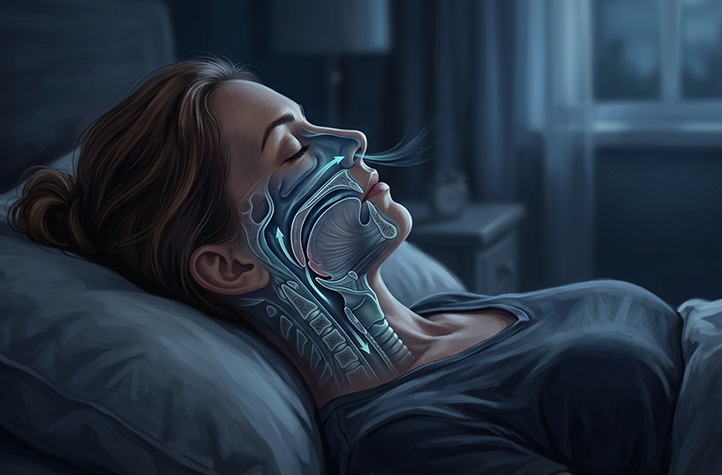
The vast majority of sufferers have Obstructive Sleep Apnea (OSA). This is a mechanical issue. When you fall asleep, the muscles in the back of your throat relax. In an OSA patient, these muscles relax too much. The tongue and the soft palate collapse backwards, effectively sealing off your windpipe. It is exactly like trying to breathe through a wet sponge.
The second type is Central Sleep Apnea (CSA). This has absolutely nothing to do with a blocked throat. Instead, it is a communication failure. Your brain simply forgets to send the chemical signal telling your lungs to breathe.
The Root of the Problem
Understanding why this happens requires looking closely at your anatomy and your daily habits. When medical professionals investigate sleep apnea causes, they look at a combination of physical traits and lifestyle choices.
Weight is the biggest risk factor. Fat around the neck presses down on the airway when you lie flat — and for a lot of people, that's enough for the throat to collapse during sleep.
But plenty of people with this condition aren't overweight at all. Anatomy does a lot of the work. A naturally thick neck, a deviated septum, large tonsils, a jaw that sits further back than usual — any of these can leave the airway just narrow enough to cause trouble. Age factors in too, because throat muscles gradually lose their firmness, and what held open fine at thirty may not hold at fifty-five.
Alcohol and smoking both tip the odds further. Drinking relaxes the muscles that are supposed to keep the throat open. Smoking irritates and inflames the airway tissue. Together, they're a reliable way to make a borderline case into a definite one.
The Tell-Tale Signs
Because the actual breathing pauses happen while you are unconscious, you miss the main event. You have to rely on the sleep apnea symptoms that spill over into your waking hours, or the exhausted complaints of your partner.
The most recognisable sign is loud, persistent snoring — particularly when it's interrupted by gasping, snorting, or what sounds like choking. During the day, the tiredness is a different weight to ordinary sleepiness. It doesn't lift after a nap. It just sits there.
Waking up with a dry mouth, a sore throat, or a headache that's already waiting for you is common. So is brain fog that makes focused work genuinely hard, and a shorter fuse that people close to you tend to notice before you do.
The reason not to leave this alone is straightforward. Every time oxygen levels drop in the night, blood pressure spikes in response. Over years, that repeated stress does real damage — the risk of heart attack, stroke, and type 2 diabetes climbs to roughly three times that of someone sleeping normally. Not a small margin.
Getting a Definitive Answer
A phone recording is a great starting point, but it is not a medical diagnosis. To accurately figure out how to diagnose sleep apnea, a doctor will usually order a sleep study, known as a polysomnography.
In the past, this meant spending an uncomfortable night in a clinic hooked up to dozens of wires. Today, technology has made this much easier. Many cases can be accurately diagnosed using a portable home sleep test. You wear a small, comfortable monitor on your finger and a breathing belt around your chest while you sleep in your own bed. The device tracks your oxygen levels, heart rate, and breathing patterns, giving a specialist all the data needed to confirm the disorder.
Fixing the Problem
Once the data confirms the issue, the focus shifts to finding a solution. Learning how to treat sleep apnea usually starts with the gold standard: a CPAP machine. This device pushes a steady, gentle stream of pressurised air through a nasal mask, acting like an internal splint to keep your airway open.
While highly effective, some people simply cannot tolerate sleeping with a mask. For them, custom-made oral appliances—similar to mouthguards—that physically push the lower jaw forward to clear the airway are an excellent alternative. In cases where enlarged tonsils or a severely deviated septum are the primary culprits, minor surgery might be the most direct and permanent fix.
Is It a Life Sentence?
This brings up the most common question patients ask: Can sleep apnea be cured? The honest answer is that it depends entirely on the root cause. If your apnea is driven by excess weight, losing a significant amount of weight can completely reverse the condition. If it is caused by large tonsils, having them surgically removed can cure it. However, if it is purely down to your natural bone structure or age-related muscle loss, it might not be entirely curable, but it is absolutely, 100% manageable with the right nightly therapy.
Why You Need a Specialist
Because the root of obstructive sleep apnea is a physical blockage in the throat or nasal passages, you need a specialist who understands the intricate architecture of the head and neck. Searching for the best ENT specialist in Dubai ensures you get a thorough, physical examination of your nasal cavity, soft palate, and throat to pinpoint the exact location of the collapse.
Receiving your evaluation at a dedicated ENT hospital in Dubai gives you access to advanced endoscopic diagnostics and tailored surgical options if a CPAP machine is not working for you. Do not spend another year feeling exhausted. Getting the right diagnosis is the first step to actually enjoying your sleep again.
Frequently Asked Questions
Can thin people get sleep apnea?
Yes, absolutely. While being overweight is a major risk factor, thin people can develop it due to a naturally small airway, enlarged tonsils, or a recessed jaw.
Does sleep apnea go away on its own?
No, it is a chronic medical condition that requires intervention. Without treatment or lifestyle changes, it typically worsens over time and increases cardiovascular risks.
Is snoring always a sign of sleep apnea?
No, almost everyone snores at some point. However, loud, chronic snoring accompanied by gasping, choking, or severe daytime fatigue is a strong indicator of the disorder.
Can I use a mouthguard instead of a CPAP?
Yes, custom oral appliances made by a specialised dentist are highly effective for mild to moderate cases, or for patients who cannot tolerate a CPAP machine.