

Losing the full use of your hand because of a severe burn changes absolutely everything. Suddenly, tying your shoelaces becomes a frustrating puzzle. Making a cup of tea, typing an email, or even holding your child's hand turns into a monumental challenge.
When the skin and underlying tissues of the hand are damaged, the impact goes far deeper than the eye can see. It strips away your independence. If you are trying to navigate the aftermath of a severe hand injury, you are probably feeling overwhelmed by the medical jargon being thrown at you. Let's cut through the noise. Here is an honest, straightforward look at what it actually takes to rebuild a hand after a serious burn.
Why the Hands Require Specialised Care
The anatomy of the hand is incredibly complex. Beneath a relatively thin layer of skin lies a delicate network of tendons, ligaments, nerves, and blood vessels. Because the skin on the back of the hand is so thin, burns here easily damage these underlying structures.
As a burn heals, the skin contracts and that means the fingers get pulled inward. If left untreated, they can lock there, a contracture, which can result in permanent loss of mobility, making everyday tasks impossible. This is why immediate and specialised hand burn treatment is absolutely critical.
Understanding Burn Reconstruction Surgery
Reconstructive surgery is rarely a single event; it is a highly personalised journey. The primary goal is not just to improve the appearance of the scarred tissue, but to restore the hand's ability to move, grip, and feel.
Burn reconstruction surgery typically falls into two categories:
acute and delayed.
Acute reconstruction happens at the time of injury, sometimes during the same procedure as the initial clean-up, when there's an exposed tendon or bone that can't be left open. Delayed reconstruction is different in nature — it happens months or years later, after the scar has fully matured and stopped changing.
During these procedures, reconstructive surgery for burns employs various advanced techniques to resurface the damaged area, release tight scar bands, and improve overall hand mechanics.
Surgical Techniques: How the Hand is Rebuilt
When it comes to burn plastic surgery, surgeons rely on a toolkit of specialised procedures tailored to the depth and severity of the burn.
1. Skin Grafting
This is the most common technique for extensive burns. The surgeon takes a thin layer of healthy skin from another part of the body (the donor site) and transplants it to the hand. Split-thickness grafts are used for larger areas, while full-thickness grafts—which include the entire dermis—are often preferred for the palms and fingers because they provide better durability and less contraction over time.
2. Flap Surgery
If a burn is so deep that it has exposed bone, tendon, or joint, a skin graft won't survive. In these cases, surgeons use flap surgery. A flap involves transferring living tissue—along with its own blood supply—from a nearby or distant area to the hand. This provides the robust, vascularised tissue needed to heal complex wounds.
3. Contracture Release
If the patient's fingers are already curled tight, the surgeon cuts the tight scar bands to free the joint. Of course, cutting that band leaves a hole, so a graft or flap is immediately used to patch it.
The Recovery Journey
The surgery works, or it doesn't, based largely on what happens next.
First few days: hand elevated, held in a splint, waiting. The graft either takes or it doesn't. Once the surgeon confirms it's integrating, the splint gets adjusted and movement begins — not much, not fast.
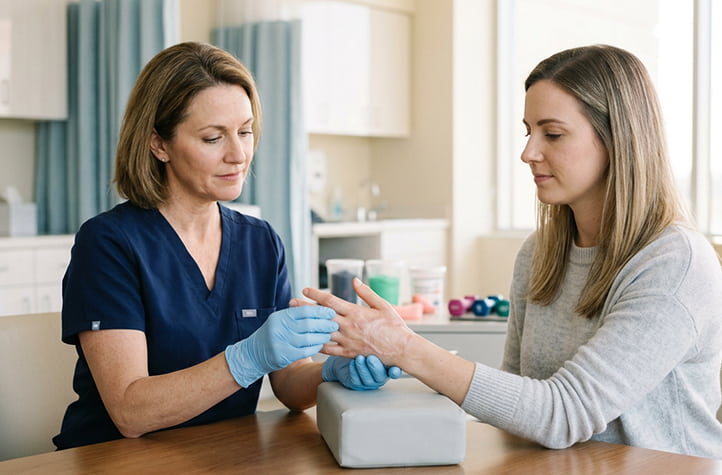
Scar tissue and new skin both tighten if they're not consistently stretched, so patients do exactly that, repeatedly, for months, through resistance that sometimes hurts. Occupational therapy runs parallel; patients relearn how to grip a cup, button clothing, pick up small objects and perform other daily activities.
Mastering Scar Management for the Long Term
Even after the surgical sites have healed, the scars will continue to change and mature for up to two years. Proactive scar management is essential to keep the tissue supple and minimise discomfort.
Silicone Therapy: Silicone gel sheets or topical silicone creams hydrate the scar tissue and help regulate collagen production, flattening raised scars.
Pressure Garments: Custom-made elastic gloves or sleeves apply constant, gentle pressure to the healing skin. This pressure helps prevent hypertrophic (raised, red) scars from forming.
Massage: Once the scars are fully closed and strong enough, regular massage helps break down dense collagen fibres, making the tissue more pliable and less sensitive.
The Importance of Choosing the Right Specialist
Because the hand is such a delicate and functional structure, you cannot trust its reconstruction to just anyone. You need a surgeon who deeply understands both microsurgery and the biomechanics of the upper limb.
For individuals seeking world-class plastic surgery in Dubai, the city is renowned for its state-of-the-art medical infrastructure, cutting-edge technologies, and stringent healthcare regulations. However, what separates the better surgeons isn't the technology, though. It's whether they treat the surgery as one part of a longer process. Hand surgery recovery involves physiotherapy, pain management, and sometimes psychological support, and those things need to be coordinated, not referred out as an afterthought.
Final Thoughts
Hand burn reconstruction is a marathon, not a sprint. Surgeons for this kind of work require specific experience for burn reconstruction. When searching for a plastic surgeon in Dubai, it is vital to look beyond general cosmetic credentials.
You must seek out a board-certified specialist at Aster Hospitals with a dedicated portfolio in burn and reconstructive microsurgery. With the right medical team and a commitment to rehabilitation, it is entirely possible to reclaim the use of your hands and, with it, your independence.
Frequently Asked Questions
How long after a burn injury can reconstruction surgery take place?
Minor reconstructive procedures can sometimes be done during the initial hospital admission. However, major reconstructive surgeries are usually delayed until 6 to 12 months after the burn has completely healed, allowing the scar tissue to mature and the initial inflammation to subside.
Will my hand look completely normal after surgery?
The primary goal of burn reconstruction is to restore function and mobility. While the appearance of the hand will improve significantly—often with smoother, less raised skin—it is unlikely to look exactly as it did before the injury. Scar camouflage techniques and meticulous surgical planning help achieve the best possible aesthetic outcome alongside functional restoration.
Is burn reconstruction surgery painful?
Any surgical procedure involves some level of post-operative discomfort. However, modern pain management protocols—including nerve blocks and oral medications—keep pain highly manageable. The stretching involved in physiotherapy is often reported as more uncomfortable than the surgery itself.
How long do I need to wear pressure garments?
Custom pressure garments are typically worn for 12 to 24 hours a day for a minimum of 6 to 12 months. The exact duration depends entirely on how the scar tissue responds and matures over time.