


Your spine silently supports you throughout the day, and understanding how to care for it is the first major step toward long-term mobility without sacrificing comfort. Most of us don't realise how much we rely on our backbone until one morning, it refuses to support us, and suddenly, even getting out of bed feels like a challenge.
You feel a sharp pain in the morning that travels from your lower back down to your leg, which is often more than simple muscle strain. In many cases, it may be caused by a herniated disc, a condition where the soft cushion between the spinal bones bulges or slips out of place and applies pressure on a nearby nerve.
The nerve roots that arise from the lower part of the spine (such as the sciatic nerve) travel downward into the hips and legs. When a herniated disc occurs, your movement can compress a nerve, leading to symptoms such as discomfort, a pins-and-needles sensation, reduced feeling, or even decreased strength in the affected area. As a result, even everyday actions like bending, sitting, or reaching can feel uncomfortable.
What is a Herniated disc?
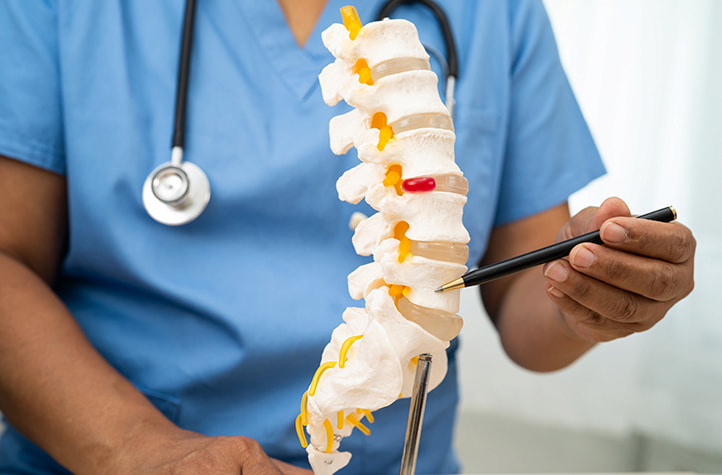
Your spine works tirelessly to support your mobility. It consists of individual bones called vertebrae, and nestled between them are soft, rubbery cushions known as discs. For ease of understanding, think of these discs as small, jelly-filled doughnuts. They have a soft, gel-like centre (the nucleus) encased in a tougher, rubbery exterior (the annulus).
A herniated disc occurs when the soft centre pushes out through a tear in the tougher outer casing. This displacement often irritates the nearby spinal nerves. While the pain can be excruciating, it is actually a mechanical issue, a structural fault rather than a systemic disease.
People often call this a "slipped disc," but that term is a bit misleading. In this condition, the disc doesn't actually ‘slip’ out of place; rather, it ruptures.
Above all, the spine is a marvel of engineering. When the cushioning between its bones fails, the impact on your quality of life can be severe. The good news is that most herniated discs can be treated with proper medical care, physiotherapy, and guided movement, and surgery is needed only in a small number of cases.
Disc Herniation Stages
This problem does not usually display a sudden onset. Usually, the affected disc goes through a slow degradation process. Medical professionals classify this progression into specific disc herniation stages. Recognising where a patient sits on this spectrum helps doctors decide on the best treatment path.
- • Disc degeneration is the first phase. The disc simply dries out, and as it loses hydration, it becomes less flexible.
- • Next comes prolapse. The disc changes shape, bulging slightly like a tyre that is losing air.
- • If it progresses, the extrusion stage begins. This is where the gel inside breaks through the wall but might still be attached.
- • Finally, there is sequestration. In this final stage, fragments of the disc gel break free and float into the spinal canal.
By pinpointing these disc herniation stages, orthopaedics can tell if the condition is manageable with rest and medication or if it requires surgical intervention to remove the loose fragments.
Herniated Disc Symptoms
Every patient experiences this differently. Some feel a dull ache, while others endure electric shocks of pain that shoot through their body. The specific herniated disc symptoms largely depend on where the injury happened and which nerve root is under pressure.
If the issue is in your lower back, you will likely feel the pain in your buttocks, thigh, and calf. It might even reach your foot. If it is in your neck, the pain shoots down your shoulder and arm. Common signs of a herniated disc condition include:
- • Radiating Pain: It isn't just a backache; it follows the path of the nerve.
- • Numbness: You might lose sensation in the area associated with the irritated nerve.
- • Weakness: Your muscles might fail you, causing you to stumble or drop things.
Herniated disc symptoms often worsen at night or after you have been sitting or standing for a long time. At times, simply coughing or sneezing can trigger a sharp spike in pain.
Bulging disc vs. Herniated disc
Confusion is common here. Patients often ask about the difference between the two. When we look at a bulging disc and a herniated disc, the key distinction is the integrity of the outer shell.
- • A bulging disc is a condition where the cushioning disc between the spinal bones pushes outward, but the outer layer remains intact. The inner material stays contained, even though the disc looks swollen.
- • In a herniated disc condition, the outer layer develops a tear, allowing some of the soft inner material to escape. When this leaked material touches or presses on nearby nerves, it is much more likely to cause sudden and intense pain.
In simple terms, both conditions involve disc changes, but a herniated disc is more likely to trigger sharp symptoms because of direct nerve irritation. However, a large bulge can also cause significant trouble if it constricts the space for nerves.
For convenient reference, here is a quick comparison to help you understand the difference:
What causes a Herniated Disc?
The causes of disc herniation often depend on genetics and the grind of daily life. Ageing is the major reason behind this medical condition. Discs become less flexible as we get older and thus more prone to tearing. However, lifestyle makes a pivotal difference. For instance, using your back muscles instead of your legs to lift heavy objects is a classic mistake that commonly leads to this condition.
Twisting and turning simultaneously while lifting is often a common cause for a rupture. Furthermore, being overweight puts additional stress on the lower back discs. Jobs that are physically demanding (requiring repetitive lifting, pushing, or pulling) naturally increase the risk. Even smoking plays a significant role. It decreases oxygen supply to the spinal tissues, accelerating degeneration.
Common Risk Factors of a Herniated Disc Include:
- • Ageing: Discs lose water content and elasticity with age.
- • Sudden strain or injury: Improper lifting or twisting movements.
- • Repetitive stress: Overuse from sports or physical labour.
- • Genetics: Family history of spine problems.
- • Obesity: Increases stress on spinal structures.
Diagnosis and Treatment Options for Herniated Disc
Doctors, especially neurologists or orthopaedists, usually start with a physical exam. They will check your reflexes, muscle strength, and walking ability. If they suspect a disc issue, an MRI scan provides a clear picture of the soft tissues. This confirms the diagnosis and rules out other potential problems.
Most patients recover with conservative treatment. Rest, physiotherapy, and anti-inflammatory medications are effective in settling the inflammation. If the pain persists, doctors might suggest steroid injections to calm the nerve directly. It is only when these measures fail, or if there is significant nerve damage, that a specialist will recommend surgery to remove the herniated portion of the disc.
When to See a Doctor
You should not ignore back pain and suffer in silence. If you experience persistent discomfort for a long time, you should immediately visit the best neurologists in Dubai to guide you through the effective diagnosis and recovery.
Whether you need medication or a complex procedure, the facility matters just as much as the doctor. Aster Hospitals, as the best neurosurgery hospital in Dubai, will provide a multidisciplinary approach to herniated disc treatment. Our team of experienced doctors combines the expertise of top neurologists with advanced spinal surgeons.
The Bottom Line
A herniated disc is more than just a backache. In fact, it is a structural failure that demands medical attention. By understanding the disc herniation stages and recognising the early herniated disc symptoms, you take the first step towards recovery. Distinguishing between a bulge and a herniation helps you have informed conversations with your doctor.
If you suspect you have this condition, do not put off seeking consultation. Seek help immediately and visit Aster Hospitals to consult the best neurologists in Dubai. With expert care and a dedicated recovery plan, you can overcome the pain, heal your spine, and return to normal activity.
Frequently Asked Questions
1. Can a herniated disc heal on its own?
Yes, the body can reabsorb the herniated material over time. However, this takes weeks or even months. Most patients find relief through physical therapy and medication well before full anatomical healing occurs.
2. What are the most common symptoms of a herniated disc?
If the pain shoots down your leg (sciatica) or causes numbness and weakness, it is likely nerve-related. A sharp pain when sneezing is another strong indicator. An MRI confirms the diagnosis.
3. Can a herniated disc heal without surgery?
Most patients recover without surgery. Doctors usually explore non-surgical options like rest and physiotherapy first. If all other options like physiotherapy, medication, etc. fail, then doctors opt for surgical solutions.
4. What are the first signs of a disc herniation?
The first signs are often pain, numbness, or weakness in an arm or leg. You might also feel tingling or a burning sensation along the affected nerve path.
5. How are herniated discs diagnosed?
Specialists diagnose this through a physical exam, checking reflexes and muscle strength. They usually confirm the herniated disc using imaging scans, such as an MRI, to see the damage clearly.
6. What are the initial signs of a herniated disc?
Early warnings often include localised back or neck pain. As it worsens, you may experience radiating pain, numbness in your limbs, or weakness when lifting objects.
7. When should I consult a neurologist in case of back issues?
Consult a neurologist if pain lasts more than a few weeks, radiates down your limbs, or causes numbness. Immediate care is needed for loss of bladder control.
8. Where can I find the best neurosurgery hospital in Dubai for disc treatment?
You should visit DHA-licensed, JCI-accredited facilities like Aster Hospitals. Book your appointment and consult the best neurologists in Dubai. Our specialists use best-in-class practices to ensure accurate diagnosis and treatment.
9. Is a slipped disc the same thing as a herniated disc?
They refer to the same condition. "Slipped disc" is the common term. A herniated disc is the medical term for when the nucleus of a disc protrudes through a tear in the annulus.