

Feeling unusually short of breath or becoming tired after simple everyday activities is not always a normal part of ageing. While these symptoms can have many causes, they may also indicate a problem with your heart. One possible…
Herniated Disc
Many individuals report severe back or neck pain, numbness, and sciatica every day. In such cases, our goal is to help you get relief and return to your normal movement and routine. At Aster Hospitals, we offer focused disc herniation treatment that begins with dedicated scans and leads to effective care to relieve your condition. Whether you have mild back pain or need surgery, our teams provide a clear plan and guide you through each step. We follow a structured and transparent clinical pathway for diagnosis and treatment.
Our team of specialists evaluates each case individually to ensure highly personalised treatment planning. Our approach to herniated disc treatment and slipped disc treatment includes physical therapy, non-surgical relief, and surgery when needed. We use advanced imaging to detect the issue early. We also help you prevent future injury & promote healthy recovery by showing you better posture and strength habits. If you require further support from our surgeons, we will prepare you for a smoother recovery from disc herniation issues.
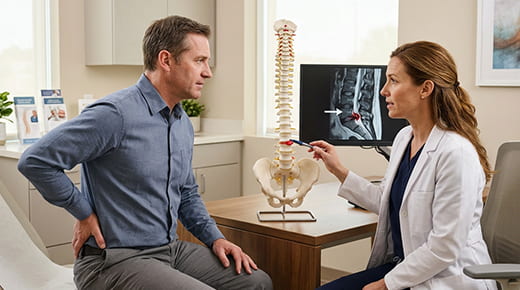
Herniations are classified as disc protrusion, extrusion, or sequestration depending on the extent of displacement. A herniated disc occurs when part of the soft disc inside the spine protrudes beyond its normal anatomical boundary. This can apply pressure on nearby nerves and cause pain of varying degrees. You may also hear it called a slipped disc or ruptured disc. It often affects the neck or lower back.
Your spine has bones called vertebrae. Between each vertebra is a disc that works like a shock absorber. When the outer layer of this disc tears or weakens, the inside part may herniate through the annulus fibrosus and create pressure on the nerve roots.
A bulging disc means the disc is still whole but pushed out. A herniated disc means the disc has torn. Degenerative disc disease means the disc has worn down over time. All three require different types of care.
If left untreated, a herniated disc can lead to serious complications affecting nerve function and mobility. Common herniated disc complications include chronic back or neck pain, nerve compression causing numbness or weakness, and reduced movement. In severe cases, conditions such as sciatica or loss of bladder and bowel control may occur, requiring urgent medical care. Early diagnosis and dedicated herniated disc treatment in Dubai can help prevent long-term damage and improve recovery outcomes.
A herniated disc can occur due to a single injury or from gradual wear over time. The following are often the main causes:
Lifestyle factors such as smoking, lack of exercise, and jobs that involve heavy lifting increase the chances of significant disc damage.
Disc herniation diagnosis begins with a physical examination and medical history survey. Questions about symptoms, past injuries, and daily activities are addressed. Diagnostic testing follows, with these tools helping confirm the issue:
Non-surgical treatment is usually the first course of action. If symptoms persist despite 6–12 weeks of structured conservative management or the case is urgent, surgical intervention may be considered.
Minimally invasive surgery involves minor cuts and faster healing. Traditional surgery is needed in more complex cases.
We offer both non-surgical and surgical care. Treatment depends on the severity of the disc damage and its impact on daily life.
Surgery may not always be the first step, but when done at the right time, it can provide significant clinical improvement. With access to some of the ‘best neurosurgeons in Dubai’ having expertise in advanced spine surgery and minimally invasive techniques, these are the benefits you can avail:
Preparation helps the surgery go smoothly, and recovery stays on track. Preoperative preparation follows standard clinical protocols. These are the parts of our process:
Targeted exercises play an important role in herniated disc treatment and recovery. Core strengthening exercises help stabilise the spine and reduce pressure on affected discs. McKenzie exercises (extension, flexion, side-glide, posture correction) are commonly recommended to relieve nerve compression and improve spinal alignment. Gentle stretching, including hamstring and lower back stretches, improves flexibility and reduces stiffness. These herniated disc exercises should be performed under professional guidance in Dubai to avoid strain and support safe, long-term recovery.
Aster Hospital, a leading neurosurgery hospital in Dubai, treats spine conditions with structured neurosurgery and care. Our team handles diagnosis, therapy, and herniated disc surgery under one roof. Key clinical advantages include.
Disc herniation treatment is covered by most insurance providers. Our staff will explain what your plan covers and what it does not. We also offer support for billing questions, pre-approvals, and payment options. Before any test or herniated disc treatment, we share the cost to ensure complete transparency.
Disc herniation can cause persistent pain, nerve irritation, and reduced mobility if left untreated. With early diagnosis and a structured treatment plan, most patients recover successfully through conservative therapy or minimally invasive surgery. At Aster Hospitals in Dubai, we combine advanced imaging, specialised spine expertise, and personalised rehabilitation to restore smooth movement safely and effectively. If you are experiencing frequent back or neck pain, timely evaluation can reduce the risk of long-term neurological complications and support long-term spinal health.
Yes, most cases of herniated disc improve with conservative management, including physical therapy, activity modification, and pain management. Symptoms typically resolve within a few weeks to months without surgical intervention.
Yes, herniated disc surgery in Dubai carries minor risks, including recurrence. A spine specialist evaluates age, health status, and surgical type before recommending treatment to minimise these risks.
Yes, herniated disc recurrence is possible after surgery. However, with proper rehabilitation, physiotherapy, posture correction, and guided herniated disc exercises, the risk of re-herniation can be significantly reduced.
Yes, physiotherapy after herniated disc surgery is essential to restore mobility, strengthen core muscles, improve posture, and support long-term spinal stability and recovery under specialist supervision in Dubai.
Healing is supported with therapy, injections, and posture correction. Surgery is used when other steps do not work. Herniated disc treatment includes rest, physiotherapy, pain management, spinal injections, and posture correction. In severe cases, minimally invasive herniated disc surgery in Dubai may be required for effective recovery.
Yes, with appropriate herniated disc treatment, physiotherapy, and lifestyle modification, most patients in Dubai can return to normal activities, maintain mobility, and live an active, pain-managed life.
Common causes include age-related disc degeneration, improper lifting, poor posture, spinal injury, obesity, and repetitive strain, increasing the risk of herniated disc development requiring treatment in Dubai.
Last updated: 30-07-2026