


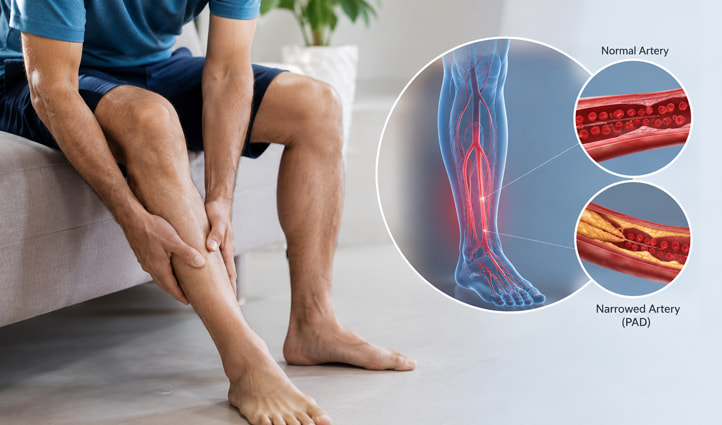
If you are experiencing painful leg cramping during walking (claudication), numb legs, and slow-healing wounds, these are common circulatory problems caused by atherosclerosis. Most people brush this off as a normal part of getting older, a touch of arthritis, or just a bit of stiffness. But this classic, stop-and-go pain is actually your body sounding a very serious alarm, which is peripheral artery disease.
Simply put, it is a common circulatory condition where narrowed arteries reduce the flow of oxygen-rich blood to your limbs. Your leg muscles are crying out for oxygen, and the pipelines delivering it are too clogged to keep up with the demand.
The Mechanics of the Blockage
To understand peripheral artery disease, you have to look at the plumbing inside your body. Healthy arteries are like flexible, wide hoses that carry blood smoothly from your heart to your extremities. Over the years, a sticky substance called plaque, made up of cholesterol, fat, and calcium, begins to coat the inner walls of these hoses. This slow buildup is known as atherosclerosis, or the hardening of the arteries.
As the plaque accumulates, the passageway shrinks. Eventually, the opening becomes so restricted that when your leg muscles demand more blood during exercise, the narrowed artery simply cannot supply it fast enough. The result is a physical squeeze of pain known in medical terms as claudication. It is exactly like pinching a garden hose while the tap is running; the water struggles to get through.
Pinpointing the Triggers
Identifying the exact causes of peripheral artery disease usually comes down to a combination of lifestyle choices and underlying genetics. Smoking is overwhelmingly the biggest offender. The thousands of chemicals in cigarette smoke directly damage the delicate inner lining of the blood vessels, making plaque build up at an alarming rate. If you smoke, your risk of developing this condition jumps exponentially.
Poorly controlled diabetes is the other major culprit. Chronically high blood sugar roughens artery walls from the inside over time, speeding up the narrowing. High blood pressure, high cholesterol, and age all make things worse.
What people often miss and doctors sometimes fail to stress is that PAD is not just a leg problem. If the arteries in your legs are clogged, the same process is almost certainly happening in the arteries going to your heart and brain. You are not dealing with a local issue. You are dealing with a body-wide one.
Recognising the Warning Signs
Catching this condition early gives you a massive advantage, but recognising the warning signs requires you to pay close attention to your body. For many individuals, peripheral artery disease symptoms start so subtly that they are completely ignored or attributed to the natural ageing process.
The hallmark sign is intermittent claudication. This is a very specific type of muscle pain, aching, or heaviness in the legs, usually the calves, that consistently happens when you walk and disappears within a few minutes of resting. However, PAD symptoms are not limited to just pain. You might notice that the skin on one of your legs feels noticeably colder to the touch than the other.
The hair on your lower legs and toes might stop growing entirely. Minor cuts or sores on your toes might take weeks or months to heal, or the skin on your feet might change colour, turning pale or slightly bluish when your legs are elevated. In the most severe stages, the pain can even strike when you are lying flat in bed at night.
Getting a Clear Picture
Because these signs develop so gradually, getting a formal and accurate evaluation is vital. A peripheral artery disease diagnosis is surprisingly straightforward and completely painless. It usually begins with a simple physical examination where the doctor checks the pulse in your feet and listens to the blood flow using a stethoscope.
The gold standard initial test is called the Ankle-Brachial Index. A nurse or doctor wraps standard blood pressure cuffs around your upper arms and your ankles, comparing the two readings. If the blood pressure in your ankle is significantly lower than the blood pressure in your arm, it points directly to a blockage between the heart and the leg. From there, if further detail is needed, a doctor might order a Doppler ultrasound to actually visualise the blood flow, or an angiogram, which uses a special dye and X-rays to map out the exact location and severity of the narrowing.
Restoring the Flow
Treating this condition requires a two-pronged attack: stopping the plaque from getting any worse, and physically restoring the blood flow to your limbs. In the early stages, aggressive lifestyle changes are the most powerful tool available. Quitting smoking completely, adopting a heart-healthy diet, and starting a strictly supervised walking programme can literally force your body to build tiny new blood vessels around the blockages. Doctors will also prescribe medications to aggressively lower cholesterol, prevent blood clots from forming in the narrowed arteries, and manage blood pressure.
When medication and lifestyle changes aren't enough, the next step is usually a procedure. Angioplasty is the most common. A thin catheter goes into the artery, a small balloon inflates at the blockage to push the plaque flat against the wall, and in most cases, a metal stent is left in place to keep it open.
Why Timely Vascular Care Is Essential for PAD
Arterial disease isn't something a GP can manage beyond a point. If you have leg pain that keeps coming back, a wound on your foot that simply won't close, or a long history of smoking or diabetes, you need a vascular surgeon, someone who looks at what's actually happening inside the vessels, not just what's showing up on the surface.
At Aster Hospitals, the team of vascular surgeons and interventional cardiologists have access to the full range of interventions, from angioplasty to bypass surgery. Getting that assessment early, before tissue damage becomes irreversible, is what makes the difference between keeping a limb and losing it.
Receiving your diagnostic work and treatment at one of the leading vascular surgery hospitals in Dubai ensures you benefit from the most advanced imaging technology, state-of-the-art catheter labs for minimally invasive procedures, and comprehensive post-operative rehabilitation. Do not ignore the warning cramp in your calf. Taking action early can save your mobility, and quite possibly, your life.
Frequently Asked Questions
Is peripheral artery disease curable?
No, the underlying buildup of plaque in the arteries cannot be completely cured. However, the progression of the disease can be halted, symptoms can be effectively managed, and blood flow can be restored through lifestyle changes, medication, or minimally invasive procedures.
Does PAD always cause leg pain?
A significant number of people with PAD are completely asymptomatic. Others might just experience leg heaviness or fatigue without actual pain, making regular screening vital for high-risk individuals like smokers and diabetics.
Can peripheral artery disease lead to amputation?
Yes, in severe and untreated cases. If the blood flow is critically restricted for too long, the tissue in the toes or foot can die (gangrene). This is exactly why early diagnosis and treatment are so crucial.
How fast does PAD progress?
The progression varies wildly from person to person. For someone who quits smoking and controls their diabetes, the disease can stabilise for years. For someone who continues to smoke, the narrowing can advance rapidly.