

Feeling unusually short of breath or becoming tired after simple everyday activities is not always a normal part of ageing. While these symptoms can have many causes, they may also indicate a problem with your heart. One possible…
EMG Studies
Dealing with unexplained muscle weakness, tingling, or numbness can be incredibly frustrating, especially when the reason is unknown. These symptoms are your body’s way of signalling that something is off in your nervous system, and getting clear answers is the first step toward relief.
At Aster Hospital UAE, we use advanced EMG studies to assess these situations. By evaluating the electrical activity within your muscles and nerves, our neurology team can point out the exact cause of the discomfort and create a targeted treatment plan to help you get back to living pain-free.
Our specialists take the time to understand your symptoms in detail and explain the findings clearly, so you know what to expect at every stage of care. With timely diagnosis and personalised treatment, many nerve and muscle conditions can be managed more effectively and with better long-term outcomes.
Electromyography EMG is a specialised diagnostic tool used to evaluate the health of the muscles and the nerve cells or motor neurons, which help in the movement. Motor neurons transmit electrical signals from your brain to your muscles, telling them when to contract.
An electromyography test translates these electrical signals into graphs, numbers, and sounds that a neurologist can interpret. If there is a problem with your nerves, the muscles they control, or the communication between them, EMG studies will detect it.
When a doctor orders an EMG, they are almost always referring to a two-part assessment: the EMG NCV test. These complementary procedures work together to give a complete picture of your neuromuscular health.
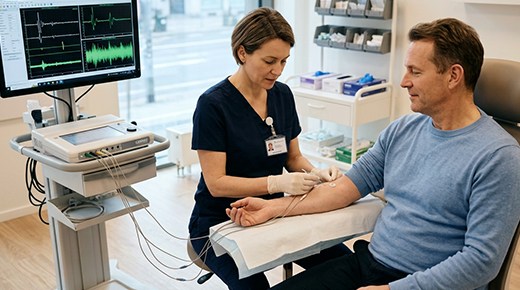
This part of the test measures how fast and how strongly electrical signals travel along your nerves. Small electrodes are placed on your skin over the nerve being tested, and a mild, quick electrical pulse is delivered.
If your doctor suspects a condition like myasthenia gravis, where your muscles weaken with activity and improve with rest, they will use an RNS study. This is a specialised extension of the NCV test. Instead of a single electrical pulse, the nerve is stimulated with a rapid series of pulses.
We then measure the muscle's response to see if the communication between the nerve and the muscle is fatiguing. A healthy muscle handles the repetitive signals easily, but in myasthenia gravis, the muscle's response drops off significantly, giving us a clear, precise diagnosis.
During the actual EMG procedure, a neurologist inserts a very fine, sterile needle electrode directly into the muscle. This electrode acts like a microscopic microphone, picking up electrical activity in your muscle both at rest and when you gently contract it.
An electromyography test is a vital tool for the accurate diagnosis of a wide range of nerve and muscle disorders. If you are experiencing symptoms, this test helps your doctor determine if the issue lies in your muscles, your nerves, or the junctions between them. We use EMG studies to help diagnose:
You should request a consultation with a neurologist in Dubai if you are experiencing:
Your primary care doctor has recommended an EMG test and a neurology evaluation to investigate your symptoms further.
Getting an accurate EMG reading requires more than just plugging in a machine; it requires the skilled interpretation of an expert. As a leading neurology hospital in Dubai, Aster Hospital UAE provides a superior diagnostic experience.
Moreover, patients can visit our facilities for EMG studies in multiple locations in Dubai, including Mankhool, Al Qusais, Jebel Ali, and Muhaisnah.
At Aster Hospital UAE, your neuromuscular health is in highly capable hands. Our internationally board-certified team includes some of the most experienced specialists for EMG Dubai has to offer. They combine their deep clinical expertise with a compassionate approach, ensuring that from the moment you walk in for your test to your follow-up care, you feel supported, informed, and confident in your path forward.
Most patients tolerate the test very well. The NCV portion involves quick, mild shocks that feel like a brief static zap. During the EMG, you will feel a slight pinch when the fine needle is inserted, and possibly a dull ache when the muscle is active. We prioritise your comfort and take breaks if needed.
The entire EMG NCV test usually takes between 30 and 60 minutes, depending on how many nerves and muscles your neurologist needs to examine.
Preparation is simple. Avoid applying any lotions, creams, or oils to your skin on the day of the test, as they can interfere with the electrodes. Wear loose, comfortable clothing, and let your doctor know about any blood thinners you are taking, though it is rarely necessary to stop them for this specific test.
There is no recovery time needed. You can return to your normal daily activities immediately. Your neurologist will review the data from your EMG studies, and in most cases, they will discuss the results and the next steps in your care plan with you before you leave the unit.
Last updated: 14-07-2026