

Chemical peels are a common cosmetic dermatology treatment. While they often target harmless concerns like mild uneven skin tone, they can also treat serious issues. These include precancerous growths or severe acne scarring. As…
Cardiac MRI & CT Angiography
Caring for the heart involves much more than occasional check-ups. Instead, it requires a deep dive into your cardiovascular health using the most reliable tools available today, like a CT angiogram. In a fast-paced life, stress and lifestyle factors can place significant strain on the heart.
A CT angiogram maps the coronary arteries directly, in three dimensions. A stress test, by contrast, shows how the heart responds under exertion, not what the vessel walls actually look like.
At Aster Hospitals, the scan is used to confirm or rule out coronary artery disease before it culminates in chest pain or a cardiac event.
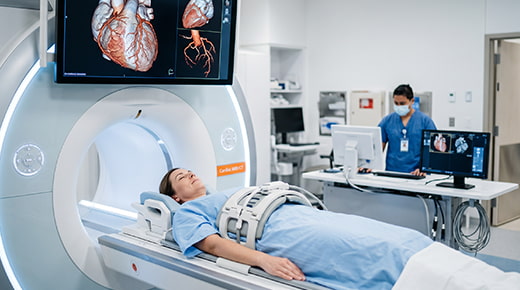
Contrast dye is injected, and a rapid-sequence CT scanner captures cross-sectional images of the coronary arteries as the dye flows through them. A radiologist and cardiologist then review those cross-sections for narrowing, calcified plaque, and soft plaque that has not yet caused symptoms.
None of this requires an incision. Where surgery was once the only way to see inside the arteries, X-rays and contrast dye now fulfil the same purpose from outside the body. Aster Hospitals offers a non-invasive CT coronary angiogram in Dubai to check heart arteries for blockages.
People often use the two terms interchangeably, but they are not identical.
In practice, most patients are referred for a heart CT scan in Dubai, like angiography, for suspected coronary artery disease, since it shows the arteries directly.
Scan duration: The CT angiography scan usually takes around 10–20 minutes.
Total appointment time: Allow approximately 30–45 minutes for the complete procedure, including IV line placement, heart-rate preparation and contrast injection.
Heart-rate preparation: A slower, steady heart rate helps produce clearer images. Patients with a fast resting heart rate may receive a mild beta-blocker before the scan.
Sedation: Sedation is generally not required for CT angiography.
After the scan: Most patients do not need to stay in a recovery room and can leave for home after the procedure.
The price depends on the scan type and whether it includes additional cardiac assessments. Aster Hospitals provides accurate pricing before confirming the appointment, helping patients understand the expected cost in advance.
Aster Hospitals’ medical excellence rests on a simple foundation, i.e., putting the patient's well-being at the forefront. At our best heart hospital in Dubai, the cardiology department is designed to feel less like a clinical environment and more like a space for holistic healing.
Moreover, Aster Hospitals holds international accreditation for its cardiac imaging and cardiology departments, and offers interventional cardiology on-site. A scan that turns up a blockage does not mean a referral elsewhere; it moves straight into consultation and treatment planning.
The scanners themselves reduce radiation exposure compared with older CT equipment, without sacrificing the resolution needed to catch plaque early. Radiologists, cardiologists, and imaging technicians work from one patient file, and the time gap between the scan and the follow-up consultation is usually short.
In addition, patients can visit the nearest Aster Hospitals branch in Dubai: Mankhool, Al Qusais, Jebel Ali, and Muhaisnah.
Many people search online: Who is the best cardiologist in Dubai? As with hospital rankings, "best" is not an official designation, but it is commonly used to describe cardiologists with an extended track record in coronary imaging and interventional cardiology.
Aster Hospitals' cardiology department is led by specialists with decades of clinical experience reading coronary CT studies and managing coronary artery disease from diagnosis through treatment. During the results consultation, the cardiologist reviews the scan images directly with the patient, rather than issuing a written report alone, and explains what the findings mean for daily life, medication, or further procedures.
Yes. Reviewing kidney function and allergy history before the scan is essential to confirm that the contrast dye carries no added risk for that individual.
Avoid caffeine for 24 hours beforehand and do not eat for a few hours before the appointment. A preparation checklist is sent at the time of booking.
Reports are typically ready within 24 to 48 hours and are sent directly to the referring doctor so treatment, if needed, can begin without delay.
Yes. The procedure does not involve sedation or anaesthesia, so patients can drive and resume normal activity immediately afterwards.
In some cases, a mild beta-blocker may be given if the resting heart rate is too fast for clear imaging, since a steady heart rate produces more detailed pictures of the arteries.
The scan takes 10 to 20 minutes; the full visit, including preparation and contrast injection, usually takes 30 to 45 minutes.
Last updated: 20-08-2026