
Feeling unusually short of breath or becoming tired after simple everyday activities is not always a normal part of ageing. While these symptoms can have many causes, they may also indicate a problem with your heart. One possible…
Botox
Botox therapy is one of the most clinically studied aesthetic treatments in use today. At Aster Hospitals, Dubai, our qualified and experienced dermatologists first listen to the candidate's requirement, and the injection plan follows from that conversation, not from a template. If a patient's concern is better addressed by a different modality, dermal filler, laser resurfacing, or a combination approach, that is the recommendation they will give to the person visited for wrinkle reduction.
Botox is a purified preparation of botulinum toxin type A. This purified toxin is injected into a specific facial muscle, which temporarily interrupts the acetylcholine signal that tells that muscle to contract. The muscle stops pulling and the skin above it flattens. Lines caused by years of squinting, frowning, or raising the brows become noticeably less deep.
This is not a filler and it does not add volume or plump the skin. It simply relaxes the muscles that were creating the crease to begin with. That distinction matters when choosing the right treatment.
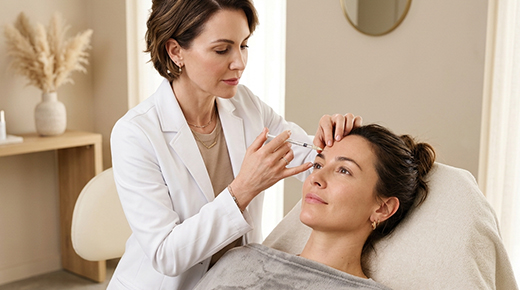
The Botox procedure itself takes between 15 and 30 minutes, depending on how many areas are addressed. A very fine needle delivers small, precise doses into pre-mapped injection points. No general anaesthesia, no recovery room. Patients leave and carry on with the rest of their day.
Our dermatologists in Dubai use Botox across a wider range of conditions than most patients realise:
Initial softening appears within three to five days. However, the peak effect is at around 14 days, but most patients see results lasting between three and six months. After that, the treated muscle gradually regains movement, and lines begin to return to their prior depth. Repeat treatments at appropriate intervals can produce a longer-running improvement over time, though the timeline varies between individuals.
However, mild redness and occasional bruising at injection sites are the most common side effects, and the good news is that both resolve quickly. Among dermatology hospitals in Dubai, the standard of pre-procedure assessment here is one that patients consistently reference when they return.
The clinical context for Botox treatment in Dubai is not always the same. At Aster, the botulinum toxin products used are licensed, stored under correct cold-chain conditions, and prepared within approved dilution ranges. Dosage is calculated per patient, based on observed muscle strength and movement, and not on a standard unit count applied to everyone.
Furthermore, the Botox specialists in Dubai at Aster Hospitals hold postgraduate qualifications in dermatology and aesthetic medicine. They are straightforward about what the treatment can and cannot achieve. We offer the standard of pre-procedure assessment before Botox treatment to ensure an optimum outcome after the procedure.
A two-week follow-up review by the dermatologist in Dubai is built into the process. If there is any asymmetry or an area that needs a minor adjustment, that review is the appropriate time to address it.
At Aster Hospitals, Botox treatment in Dubai is performed by dermatologists trained in aesthetic medicine and facial anatomy. Each specialist evaluates muscle movement, skin condition, and patient concerns before planning treatment. Our Botox specialists in Dubai focus on precise dosing and natural-looking results, following standard clinical protocols across our dermatology hospitals in Dubai.
There isn't a fixed age. Many people choose to begin in their late 20s or early 30s when fine lines start to stay even at rest, while others may start earlier for preventive reasons.
Usually, a Botox treatment takes 15 to 30 minutes. However, the timeline significantly depends on how many areas are treated.
It is generally considered safe when performed by a qualified professional using approved products. Minor effects like slight redness or bruising at the injection site can occur.
Botox is contraindicated during pregnancy and breastfeeding, in patients with neuromuscular conditions such as myasthenia gravis or Lambert-Eaton syndrome, and in individuals with a documented hypersensitivity to botulinum toxin or its excipients. A full medical history review takes place before any treatment proceeds.
Last updated: 22-05-2026