

Feeling unusually short of breath or becoming tired after simple everyday activities is not always a normal part of ageing. While these symptoms can have many causes, they may also indicate a problem with your heart. One possible…
Stroke Management
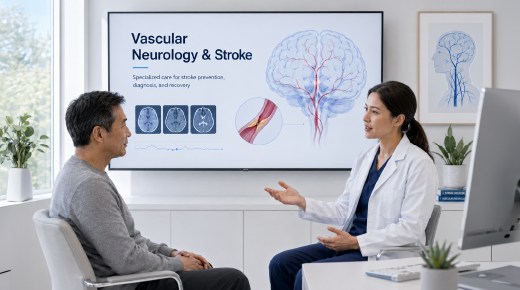
A stroke is a critical medical emergency where every second counts. The faster you receive expert care, the better your chances of recovery and of minimising long-term brain damage. At Aster Hospitals UAE, we provide rapid, advanced stroke treatment designed to restore blood flow, protect your brain cells, and guide you through a comprehensive recovery journey. We don't just respond to the emergency; our specialised stroke team actively manages your neurological health, from the acute phase to long-term rehabilitation, ensuring the best possible outcome.
Stroke management is a highly specialised, time-sensitive medical process dedicated to treating interruptions in the brain's blood supply. Whether caused by a blockage (ischemic stroke) or a bleed (hemorrhagic stroke), the brain is deprived of vital oxygen, causing cells to die rapidly. Because this directly impacts the body's control centre, our stroke team must possess expert knowledge of neurovascular anatomy, advanced interventional techniques, and the complex critical care protocols required to save brain tissue and lives.
Our neurology and neurovascular team provides specialised care for a wide range of cerebrovascular events, ensuring your treatment plan is tailored specifically to the type of stroke you are experiencing.
In a stroke, "time is brain." Safety and accuracy begin the moment you enter our doors. As a leading neurology hospital in Dubai, we use rapid, rigorous testing to determine the exact nature of the stroke.
Rapid CT Scan: Immediately distinguishes between an ischemic stroke (blockage) and a hemorrhagic stroke (bleed) to dictate the course of emergency stroke treatment.
CT Angiography (CTA): Visualises the blood vessels in the brain and neck to pinpoint the exact location of a clot or vessel rupture.
MRI Brain (Diffusion-Weighted Imaging): Detects even the smallest areas of brain tissue damage within minutes of symptom onset.
Carotid Ultrasound: Assesses blood flow and identifies blockages in the neck arteries that may have caused the stroke.
Echocardiography: Evaluates the heart for blood clots or structural issues that could travel to the brain.
Managing a stroke requires a precise, rapid mix of medical therapy, advanced surgical interventions, and expert timing to restore blood flow and relieve pressure on the brain.
Intravenous Thrombolysis (tPA/Alteplase): The gold-standard clot-dissolving medication administered immediately for ischemic strokes to restore blood flow and minimise damage.
Blood Pressure & Intracranial Pressure Control: Precise medication management to stabilise vital signs and protect the brain from secondary swelling or bleeding.
Craniotomy: Emergency surgery for hemorrhagic strokes to relieve life-threatening pressure on the brain.
Surviving a stroke is just the first step; comprehensive stroke management in Dubai includes long-term recovery and prevention.
Physical & Occupational Therapy: Targeted exercises to rebuild strength, coordination, and independence in daily activities.
Anticoagulant Therapy: Blood thinners and antiplatelet medications are prescribed to prevent recurrent strokes.
Lifestyle Modification: Nutritional guidance, smoking cessation, and diabetes management to address the root causes of vascular disease.
A stroke is an emergency, and you should immediately seek a stroke specialist if you or a loved one experiences any "BE FAST" symptoms:
Balance: Sudden loss of balance or coordination.
Eyes: Sudden blurred vision or loss of sight.
Face: Facial drooping on one side.
Arms: Arm weakness or numbness on one side of the body.
Speech: Slurred speech or inability to understand words.
Time: Time to call emergency services immediately.
Additionally, you should consult a neurologist in Dubai if you have experienced a TIA (mini-stroke), as this is a critical warning sign that a major stroke may be imminent.
Aster Hospitals are recognised as a premier stroke management hospital because we offer a level of emergency response, monitoring, and technology that matches global standards.
Experienced Stroke Team: Our neurologists and neurosurgeons have years of experience managing complex cerebrovascular emergencies.
Advanced Technology: We utilise bi-plane angiography systems, rapid CT imaging, and state-of-the-art ICU monitoring.
Multidisciplinary Approach: As a dedicated stroke management hospital, we bring emergency physicians, neurologists, and rehabilitation therapists together for a seamless care plan.
Patient-Centric Care: We prioritise rapid intervention and compassionate family communication, explaining every critical step of the journey.
We are home to some of the best stroke specialists and neurologists in Dubai. The team collaborates daily with emergency doctors and neurosurgeons to ensure that from the moment you arrive at our doors to your final rehabilitation session, your brain is in the safest hands possible. When it comes to advanced stroke treatments in Dubai, our international board-certified specialists deliver unmatched, life-saving expertise.
An ischemic stroke is caused by a blood clot blocking an artery to the brain, while a hemorrhagic stroke is caused by a weakened blood vessel that ruptures and bleeds into the brain. The emergency stroke treatment for each is entirely different.
The golden hour refers to the critical window of time—usually within 4.5 hours of symptom onset—where clot-dissolving medications (tPA) and mechanical thrombectomies are most effective at saving brain tissue and reversing disability.
Yes, many patients can achieve significant or full recovery, especially if they receive immediate medical intervention and undergo intensive, early rehabilitation. The brain's ability to rewire itself (neuroplasticity) plays a huge role in recovery.
A Transient Ischemic Attack (TIA) causes stroke-like symptoms that resolve on their own within minutes or hours. However, it is a medical emergency and a major warning sign of a future, more severe stroke, requiring immediate evaluation by a stroke specialist.
Last updated: 03-07-2026