

Feeling unusually short of breath or becoming tired after simple everyday activities is not always a normal part of ageing. While these symptoms can have many causes, they may also indicate a problem with your heart. One possible…
Cranioplasty Surgery
At Aster Hospitals Dubai, cranioplasty surgery is performed to repair skull defects and restore its protective structure after head trauma, decompressive craniectomy, or neurosurgical procedures. Our neurosurgical team provides advanced skull reconstruction and cranial repair surgery using customised implants and evidence-based surgical planning. Patients seeking cranioplasty surgery in Dubai at Aster Hospitals receive a structured diagnostic evaluation, 3D-designed customised implants, and coordinated postoperative rehabilitation.
The cranioplasty procedure involves reconstructing a missing or damaged section of the skull using bone grafts from other parts of the body, or biocompatible synthetic implants such as titanium, PEEK, or polymethyl methacrylate (PMMA). This procedure restores cranial protection, intracranial pressure stability, neurological function, and cranial symmetry, while also improving psychological well-being. Aster Hospitals in Dubai are equipped with specialised neurosurgical operating suites and a multidisciplinary team to effectively attend emergency cases.
Cranioplasty is a neurosurgery-based procedure used to repair a skull defect by reconstructing the missing cranial bone using either preserved bone grafts or customised synthetic implants. It is commonly performed after decompressive craniectomy, traumatic skull fractures, tumour surgery, or congenital cranial deformities. The cranioplasty operation protects the brain and restores the natural shape of the head and skull.
Our team at Aster Hospitals uses CT scans and 3D modelling to plan every cranioplasty procedure precisely. We work to ensure the implant or graft matches the skull shape and provides a long-term solution.
Cranioplasty is recommended when a skull defect remains, often after significant trauma, exposing the brain to potential injury, neurological complications, or cosmetic deformity. These cases often arise from trauma, decompression surgery, or genetic abnormalities.
Traumatic accidents can lead to bone loss in the skull. Cranioplasty helps restructure the missing portion to safeguard brain function and restore normal shape.
In some cases, part of the skull is removed to reduce brain pressure. Later, cranioplasty helps close the gap once swelling has resolved.
Birth-related skull abnormalities can interfere with healthy growth. Timely cranioplasty helps improve function and support cranial development.
Certain infections can damage the skull bone. After infection control, the skull structure is restored through this planned surgical repair.
Even after the brain heals, visible skull depressions can remain. Reconstructive cranioplasty addresses these and supports psychological recovery.
Symptoms that may indicate the need for skull reconstruction or cranioplasty surgery include:
Our diagnostic team evaluates all symptoms before surgery planning.
Aster Hospitals, as a top neurosurgery hospital in Dubai, offers advanced neurosurgical procedures, including cranioplasty and skull reconstruction. Our specialists initiate the procedure with a comprehensive pre-surgical assessment and diligently follow a standard stepwise approach that includes diagnostics, implant design, surgery, and recovery care. Each phase is supported by our neurology, imaging, and rehabilitation departments.
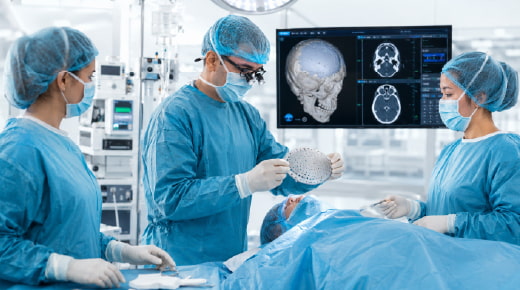
Preoperative evaluation includes neurological examination, CT scan with 3D reconstruction, MRI imaging when required, and surgical planning using computer-assisted modelling. This helps identify skull dimensions and map adjacent brain structures. 3D imaging then helps to create customised implants that fit perfectly to address the skull defect.
Cranioplasty surgery is performed under general anaesthesia in a specialised neurosurgical operating theatre. The scalp is opened to gently expose the affected bone area. Depending on your condition, our specialists either place preserved bone or fit a synthetic implant such as PEEK, titanium, or PMMA. These are fixed using titanium screws, and the site is secured with a sterile dressing.
Patients are monitored in our neuro-intensive care unit for 24 to 48 hours. We manage pain, prevent infection, and track neurological signs. Most individuals begin gentle movements within a few days and resume daily activities within a few weeks.
The implant material used in cranioplasty surgery depends on factors such as the size of the skull defect, previous infection, patient age, and surgical history. Our surgical team uses the safest and most durable options. We may use your own bone if it was preserved earlier. If not, we consider materials such as PEEK, which are strong and lightweight. We also use titanium mesh or PMMA, depending on location and requirement. Every implant is customised to your skull shape through 3D imaging before the cranioplasty procedure begins.
Our goal during cranioplasty is not only structural repair but also neurological and cosmetic restoration. We take a holistic view of patient outcomes.
Closing a defect prevents direct injury to soft brain tissue and reduces long-term risk.
Patients often report higher confidence and comfort after their head contour is corrected.
Brain function often improves when pressure normalises, and cerebral protection is re-established.
Many patients experience relief from chronic pain or tension after a successful cranioplasty operation.
With appearance restored and symptoms improved, quality of life returns to normal for most individuals.
Cranioplasty is a complex neurosurgical procedure, and like any surgery, it carries potential risks that are discussed with patients before treatment. While risks are low in experienced hands, we always share them with patients before treatment.
Infection may occur after surgery, especially if a previous infection was present. We adhere to strict protocols to reduce this risk.
In rare cases, the body may not accept synthetic material. Regular imaging helps us detect early changes.
Bleeding around the surgical area may occur. Our specialists monitor closely to prevent this complication.
Brain swelling or seizure activity may be observed post-surgery in high-risk cases. Medication and early care are used for prevention.
With our customised implants, we reduce the possibility of visual mismatches or depressions. Additional rare complications may include cerebrospinal fluid leakage, wound healing problems, or implant displacement.
Recovery depends on the cause of your skull defect, general health, and neurological baseline. Recovery after cranioplasty surgery varies depending on neurological status and the underlying cause of the skull defect. Our team at the leading ‘neurosurgery hospital Dubai’ supports you from surgery through rehabilitation.
You may be discharged earlier based on wound healing, pain control, and neurological improvement.
Light activities begin within two weeks. Work or school routine can usually be resumed in one month.
Avoid exertion for at least six weeks to protect implant integrity.
CT scans and neurological evaluations are done during the first few months.
If symptoms remain after surgery, we coordinate with our neurorehabilitation team to build a recovery plan.
Aster Hospital is a reputed neurosurgery hospital in Dubai, specialised in cranioplasty. Our neurosurgery experts deliver outcomes that combine safety, precision, and compassion. From diagnostics to surgery to rehabilitation, every step is planned with your smooth recovery in mind.
Our consultants bring deep knowledge of complex cranial repair using modern tools and evidence-based methods.
Our operation planning combines radiology with advanced design to ensure accuracy and fit.
Our facilities are equipped for complex cranial procedures with real-time monitoring and anaesthesia support.
You receive physical therapy, speech support, and cognitive care if needed to support holistic recovery.
Our teams work together across specialities so that your complete care is not limited to a single department.
Our surgical success rate, low complication rate, and patient satisfaction place us among the preferred hospitals for cranioplasty in Dubai.
Cranioplasty cost in Dubai varies based on procedure type, hospital stay, material used, and insurance coverage. Our hospital staff offers clarity on expected charges and supports insurance coordination throughout your treatment.
Cranioplasty surgery is a neurosurgical procedure used to reconstruct a skull defect using bone grafts or synthetic implants to restore brain protection and skull shape. Our team includes some of the best neurosurgeons in Dubai, experienced in complex cranioplasty surgery and cranial reconstruction procedures.
A craniotomy involves temporarily removing bone to access the brain. A cranioplasty involves reconstructing missing or damaged skull bone after surgery or trauma.
Yes, it is a significant surgical procedure that involves operating on the skull and requires general anaesthesia, hospitalisation, and postoperative recovery.
Most surgeries take between two and four hours, depending on the complexity, site of defect, and the patient's health condition.
The implant is placed beneath the scalp and designed to match your skull shape. It does not usually feel different after healing.
Rejection is rare when using biocompatible materials. We monitor healing and provide early intervention if inflammation or discomfort occurs.
You can expect a hospital stay, wound care, and recovery time. Most patients experience better protection, appearance, and function after the surgery.
Recovery after cranioplasty surgery usually takes four to six weeks, although neurological recovery may take longer depending on the underlying condition.
Last updated: 30-07-2026