


Asthma is one of the most common reasons people turn to respiratory care, yet it's often under-diagnosed and under-treated, particularly in low- and middle-income countries.
When asthma goes under-treated, people can end up…
Endoscopic Ultrasound
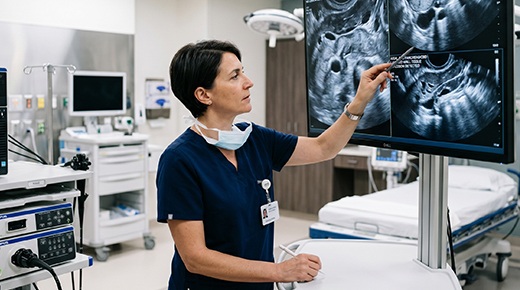
Visualising the digestive tract is fundamentally different from visualising the organs surrounding it. Standard endoscopy examines the lining of the gut, but it cannot see what lies beneath or outside the intestinal wall. Patients often present with complex issues, such as unexplained abdominal pain, suspicious growths, or bile duct obstructions, where standard imaging falls short. At Aster Hospitals, the endoscopic ultrasound department focuses on looking deeper because when it comes to diagnosing and staging tumours or evaluating pancreatic and biliary diseases, precision is everything.
Endoscopic ultrasound works by passing a scope with an ultrasound probe. The probe is built into its tip, through the mouth or rectum, placing it right next to the organ being examined. That proximity is the point. External ultrasound has to push sound waves through skin, fat, and muscle to get there; EUS doesn't. The result is a much clearer picture of the digestive tract walls and surrounding structures, including the pancreas, liver, gallbladder, biliary & pancreatic ducts and lymph nodes. A standard endoscopy handles most reflux cases fine, but when there's a question about whether something more serious is going on underneath, EUS is what actually answers it.
Patients are referred to us for a higher level of diagnostic clarity. The conditions we evaluate and treat most frequently include:
The endoscopic ultrasound procedure requires a sophisticated setup and a specialist with dual expertise in endoscopy and sonography at a standard gastroenterology hospital in Dubai:
Sedation and Scope Insertion: The patient receives sedation for comfort. The endoscope is gently advanced through the upper digestive tract.
Ultrasound Imaging: Once positioned near the area of interest (e.g., the stomach for viewing the pancreas), the ultrasound is activated to provide real-time, cross-sectional images.
Intervention and Biopsy: If a lesion is identified, the physician can pass a needle through the scope to take a biopsy. If a bile duct stone is confirmed, the same ERCP specialist can coordinate immediate therapeutic intervention.
Multidisciplinary Planning: The findings are discussed immediately with surgeons and oncologists to determine if ERCP surgery or other surgical interventions are necessary.
While EUS is generally safer than exploratory surgery, it is an advanced procedure with specific risks. The primary risk is associated with Fine Needle Aspiration (FNA), which can occasionally cause bleeding or infection. There is also a small risk of pancreatitis, particularly when the pancreas is biopsied or injected. Because this is a highly technical procedure, the ERCP test cost and endoscopic ultrasound price reflect the specialised equipment and expertise required. Choosing a premier facility ensures that these rare complications are managed promptly by expert staff.
When dealing with potential malignancies or complex pancreatic issues, accuracy is non-negotiable. Patients searching for endoscopic ultrasound hospitals in Dubai choose us because we offer the most advanced imaging technology available. As a leading endoscopic ultrasound hospital in Dubai, we provide a seamless transition from diagnosis to treatment.
Whether the result is a benign cyst or a condition requiring ERCP surgery, our multidisciplinary team ensures that the patient receives a comprehensive care plan without unnecessary delays. Moreover, patients can visit Aster Hospitals at multiple locations across Dubai as per their preference. The locations are Mankhool, Al Qusais, Jebel Ali, and Muhaisnah.
Performing EUS requires a unique set of skills—part endoscopist, part sonographer, and part interventionalist. Our team of the best gastroenterologists in Dubai and ERCP specialists is internationally renowned for its expertise in advanced endoscopy. They have performed thousands of ultrasound-guided procedures, offering patients the highest diagnostic yield in the region. They are dedicated to providing precise answers that guide life-saving treatment decisions.
No. Both endoscopic ultrasound and ERCP are performed under moderate to deep sedation or anaesthesia. You should not feel any pain during the procedure. Most patients sleep comfortably and wake up with no memory of the examination.
Both EUS and ERCP are typically outpatient procedures. Patients are usually monitored for 1 to 2 hours after the procedure to ensure the sedation has worn off and there are no immediate complications. You can generally go home the same day, though you will need someone to drive you.
While both use an endoscope, they have different primary goals. EUS is primarily a diagnostic tool used to obtain detailed images and biopsies of the GI tract walls and surrounding organs (like the pancreas). ERCP is primarily a therapeutic tool used to treat problems in the bile and pancreatic ducts, such as removing stones or placing stents.
Last updated: 03-07-2026