


Feeling unusually short of breath or becoming tired after simple everyday activities is not always a normal part of ageing. While these symptoms can have many causes, they may also indicate a problem with your heart. One possible…
Carotid Endarterectomy
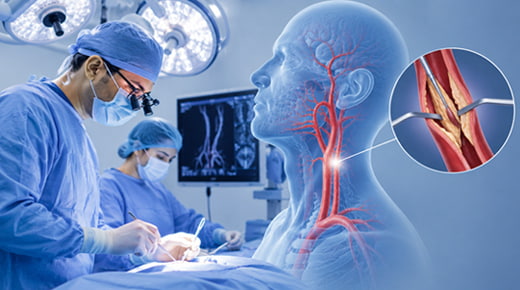
A carotid endarterectomy is a crucial vascular operation performed to clear out obstructive plaque from the carotid arteries. However, open surgery isn't the only way to protect your brain. For many patients, Carotid Artery Stenting (CAS) offers a highly effective, minimally invasive alternative. These specific vessels are the primary conduits for blood reaching your brain; if they narrow, the consequences can be life-altering.
At Aster Hospitals UAE, our 'vascular surgeon Dubai' team partners with neurologists to identify arterial narrowing early. By combining precise imaging with expert surgical and endovascular skills, we offer both CEA and CAS. Our focus is to shield your brain health and prevent the devastating impact of a stroke.
Simply put, carotid endarterectomy, or CEA surgery, is a "deep clean" for your neck's main arteries. Over the years, fatty deposits known as plaque can harden along the artery walls. This condition, called stenosis, acts like a bottleneck, starving the brain of oxygen. During CEA, your surgeon makes a precise incision in the neck, carefully opens the vessel, and physically removes the waxy buildup.
Carotid Artery Stenting (CAS), on the other hand, is an endovascular "scaffolding" procedure. Instead of opening the neck, a vascular specialist threads a thin catheter through a small puncture in the groin or wrist, guiding it up to the narrowed carotid artery. A tiny balloon is inflated to compress the plaque against the artery wall (angioplasty), and a cylindrical mesh tube called a stent is expanded and left in place to keep the artery propped open.
During CAS, a tiny umbrella-like device called an embolic protection filter is deployed first to catch any loose plaque particles, ensuring they don't travel to the brain and cause a stroke.
Our specialists do not recommend surgery or stenting lightly. Decisions are based on rigorous clinical data and the patient's overall health profile. Common indications for CEA or CAS include:
Carotid Artery Stenting is often the recommended approach for patients who have severe medical conditions that make open surgery too risky, those who have had previous neck surgeries or radiation therapy to the neck, or cases where the narrowing is in a hard-to-reach anatomical location. Conversely, CEA may be preferred for patients with very complex, heavily calcified plaques that do not respond well to stenting.
Carotid disease is often a silent threat. Many patients don't realise they are at risk until they experience a TIA. You must seek urgent care if you notice:
Getting the diagnosis right is the first step toward recovery, and it also determines whether CEA or CAS is the best route for you. Every carotid endarterectomy specialist and endovascular surgeon in Dubai at our facility has access to world-class diagnostics. We usually start with a Carotid Doppler ultrasound to hear and see how blood moves through the neck.
If we need more detail, we utilise CT Angiography (CTA) or MRA to create a high-definition map of your vascular system. This ensures that every intervention—surgical or stenting—is planned with millimetre precision.
At Aster Hospitals, carotid artery treatment is a structured, personalised care process based on your specific diagnosis.
The CEA Procedure: After the plan is finalised, the procedure is carried out under general or local anaesthesia. Your surgeon makes an incision in the neck, carefully opens the carotid artery, and removes the plaque. The artery is then often closed using a small "patch" made of synthetic material or your own vein to widen the vessel slightly and prevent future narrowing.
The CAS Procedure: This minimally invasive alternative is usually performed under local anaesthesia. The interventional specialist makes a tiny needle puncture in the femoral artery (groin) or radial artery (wrist). Using X-ray guidance, a catheter is advanced to the carotid artery. An embolic protection device (filter) is deployed beyond the blockage to catch any debris.
A balloon catheter is inflated to open the artery, and the stent is deployed to hold it open. The filter is then carefully removed, and the catheter is withdrawn. Because there is no surgical incision in the neck, recovery is significantly faster.
Each procedure carries its own risk profile.
At our vascular surgery hospital in Dubai, we use real-time nerve monitoring and advanced shunting techniques during CEA to maintain blood flow to the brain. For CAS, we utilise the most advanced embolic filters and intravascular ultrasound to ensure precise stent placement. The patient is likely to stay in the hospital for 24 to 48 hours for observation after either procedure.
While CEA patients might feel some tightness in the neck and take two weeks to return to normal routines, CAS patients often experience just minor bruising at the access site and return to light activities within a few days.
As one of the top carotid endarterectomy and stenting hospitals in Dubai, we don't just treat the artery; we treat the person. We house a multidisciplinary stroke-prevention unit under one roof, ensuring seamless collaboration between vascular surgeons, neurologists, and interventional radiologists to offer both surgical and endovascular solutions.
Aster Hospitals also offers 24/7 emergency support to address critical conditions. Moreover, patients can visit our facilities spread across multiple locations in the city, including Mankhool, Al Qusais, Jebel Ali, and Muhaisnah.
If you have been looking for the best carotid endarterectomy specialist or endovascular surgeon near me, look no further. Each of the best vascular surgeons in Dubai on our staff is a master of their craft, bringing years of expertise in both complex open CEA cases and advanced CAS stenting techniques to ensure your procedure is a success.
It is a vital surgical operation where surgeons physically cut into the neck artery and clear out fatty blockages to prevent a stroke. Aster Hospitals are recognised as the best carotid endarterectomy hospitals in Dubai for result-driven care.
CAS is a minimally invasive alternative to CEA. Instead, the specialist makes a small puncture in the groin or wrist and threads a catheter up to the blocked carotid artery, where a tiny mesh stent gets placed to compress the plaque and keep the vessel open.
Heavily calcified plaques tend to respond better to CEA. CAS is usually the better call if you've had neck surgery before, if open surgery carries too much risk, or if the blockage is somewhere hard to access. The specialist will look at your scans and history and explain which route is the more sensible one.
Patients with severe arterial narrowing (over 70%), those who recently survived a "mini-stroke" (TIA), or those with unstable plaques that could break off usually require one of these life-saving interventions.
After CEA, you will typically stay overnight for monitoring, with full recovery and return to normal routines taking about two weeks. After CAS, most patients are walking within a few hours and can return to light daily activities within just a few days, as there is no surgical neck incision to heal.
While CAS avoids the surgical risks of neck incisions, there is a slight risk that microscopic plaque debris could break loose during the procedure. We minimise this using an embolic protection filter (a tiny umbrella) to catch any debris before it reaches the brain.
Last updated: 03-07-2026